
Capture your collective “common sense”
RelationalAI’s Relational Knowledge Graph provides a common model of your business to help you observe, decide, and act.
Enhance all your decisions
RelationalAI powers composite AI reasoners to ensure you can make consistent, high-quality decisions at unprecedented speed across the entire organization.
Leverage the full potential of the data cloud
Our deep integration means you get powerful new decision tools all while maintaining your existing security and governance.
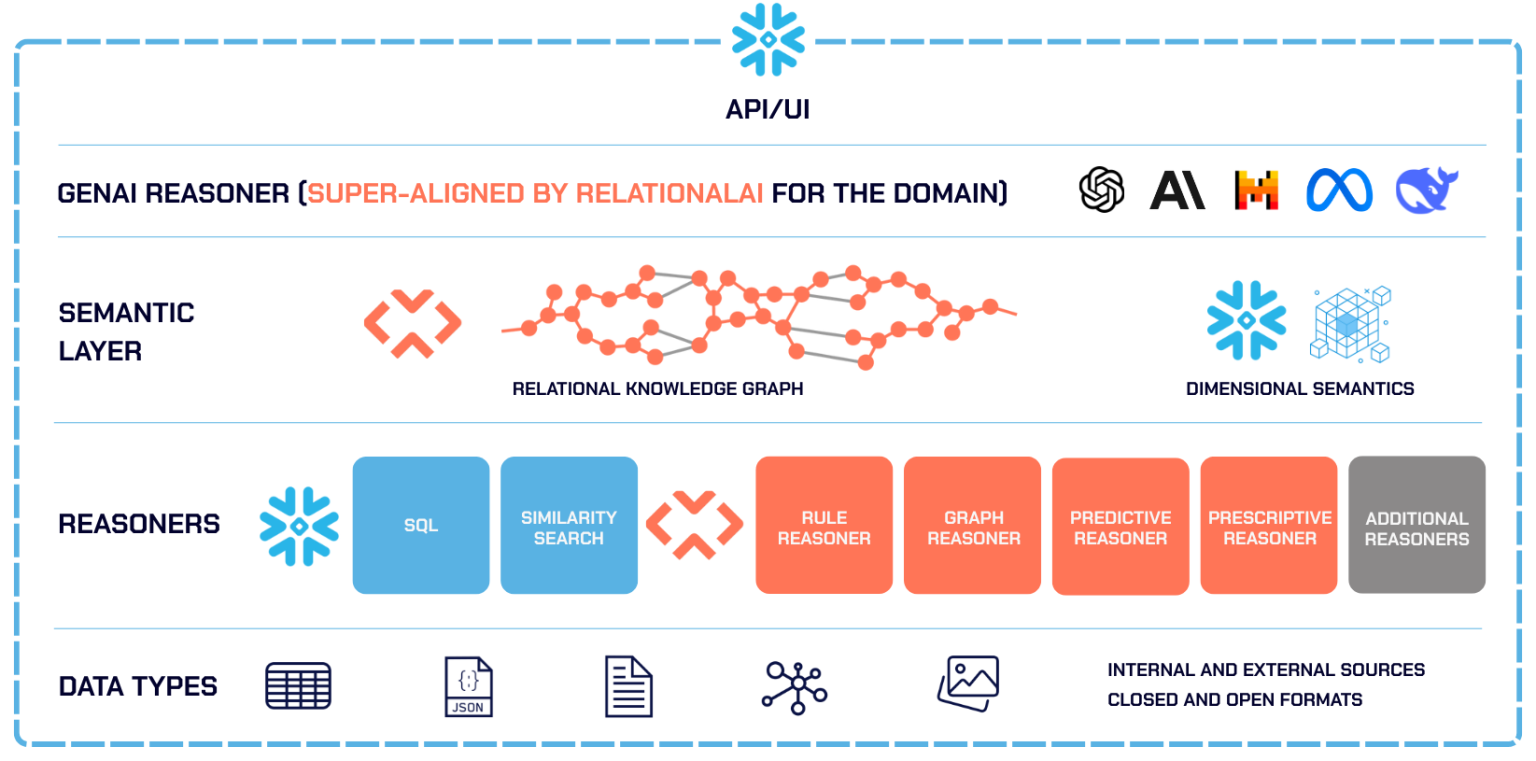
A different level of integration...
We believe that rather than creating yet another silo, knowledge graphs should live with your data and take advantage of the tremendous value you get from centralizing everything in Snowflake’s data cloud.
Since RelationalAI’s native application is built on top of Snowpark Container Services, data never leaves the Snowflake perimeter. You get the same governance and the same security, but with a new set of tools for decision making.

… for modeling your business in an expressive, executable way.
The Relational Knowledge Graph
A semantic foundation that captures business context and executes it through built-in reasoning capabilities
Advanced AI Reasoners
A new class of intelligent applications unlocked by applying advanced graph, rules, predictive and prescriptive reasoning to infer, discover, predict and optimize all aspects of your business.
LLMs super-aligned to your domain
Super-aligned GenAI question answering workflows, well beyond what you can answer with RAG and text-to-SQL.
Features and capabilities
EXPRESSIVE KNOWLEDGE MODELING
Model complex business logic, constraints, and relationships using a declarative language designed for knowledge representation. Build and compose ontologies, rules, and logic in a way that integrates seamlessly with Python and supports both verbalized and programmatic workloads.
INTEGRATED REASONING
RelationalAI provides a comprehensive set of reasoners —including rule-based, graph, predictive, and prescriptive—that operate over a shared relational knowledge graph. These reasoners are composable and interoperable, enabling compound AI workloads with explainable, logic-driven outputs.
SNOWFLAKE-NATIVE
Build relational knowledge graphs and reason over Snowflake enterprise data—no data movement, extracts, or pipelines required. Reasoning is grounded in the most current data, enabling intelligent applications that are semantically aware.
CLOUD-NATIVE, SCALABLE ARCHITECTURE
Built on a cloud-native foundation, RelationalAI separates compute and storage and scales elastically to support demanding app and AI workloads. The system extends the relational paradigm to support graph and logic-based computation, enabling intelligent apps and reasoning at enterprise scale.
ENTERPRISE-GRADE SECURITY & GOVERNANCE
RelationalAI integrates with Snowflake’s security and governance model, including support for Tri-Secret Secure (TSS) and end-to-end data encryption. Inherit existing access controls and compliance posture, ensuring secure reasoning over sensitive enterprise data.
Integrated reasoning
 Graph reasoning
Analyze interconnected data to uncover hidden patterns and relationships by leveraging advanced graph queries for path finding and graph algorithms for community detection, centrality, similarity, link prediction and path analysis. Build intelligent applications like fraud detection, customer 360, supply chain risk management, entity resolution, and more.
 Rule-based reasoning
Simplify intelligent application development with expressive and scalable rule-based based reasoning, by bringing knowledge and semantics closer to your data, reduce your code footprint by 10x, improve accuracy, and drive consistency and reusability across your organizations with common business models understood by all.
 Predictive reasoning
Predict the impact of your decisions by leveraging GenAI and Graph Neural Networks to build accurate models directly from your relational knowledge graph without the need for manual feature engineering.
 Prescriptive reasoning
Optimize complex business operations faster and more efficiently with sophisticated solvers for mixed integer programming (MIP) and satisfiability (SAT). Understand business objectives and use a conceptual model of your business to identify optimization potential quickly and easily. (Coming soon)
Demos
This video from RelationalAI demonstrates the integration between RelationalAI’s Relational Knowledge Graph (RKG)-based semantics and Snowflake’s Semantic Views. The demo shows how to create a Semantic View in Snowflake from a RelationalAI Relational Knowledge Graph, and conversely, how to enrich a Snowflake Semantic View by translating it into RelationalAI semantics.
🚀 You will be able to:
- Understand the value of the RelationalAI RKG semantics
- Use the RelationalAI semantics and the different reasoning capabilities
- Convert RelationalAI RKG semantics to Snowflake Semantics views
- Use the Snowflake Semantics view with Cortex Analyst
- Convert a Semantics view to a RelationalAI RKG-based semantics
Blue Yonder is building an intelligent, living digital twin of their supply chain using RelationalAI.
🚀 In this demo, you will see:
- A digital twin of a detailed supply chain network with key business elements like Items, Locations, Supply Methods, and Resources, all mapped in a knowledge graph.
- How advanced analytics and decision-making are enabled by enriching Snowflake data into a materialized graph view.
- A two-panel UI: the Integrated Demand and Supply Planning (IDSP) network and the high-level Integrated Business Planning (IBP) network.
- Live zooming into specific nodes, like Finished Goods at factories, and understanding upstream and downstream flows.
- Network simplification using over 400 business rules via RelationalAI’s rule-based reasoner, reducing complexity and enhancing visibility.
- Natural language querying for insights on item impact, resource dependencies, and complexity analysis.
RelationalAI powers smarter supply chain management with advanced data modeling, visualization, and optimization.
🚀 In this demo, you’ll learn:
- Data modeling: How we load and connect parts, BOMs, locations, and routes into the PATHFINDER_SE model — the foundation for powerful analysis and dependency tracing.
- Visualization: Using the Graph class to map part dependencies, spot bottlenecks, and identify critical components through intuitive, color-coded graphs.
- Impact analysis: Quickly assess the downstream impact of defective parts and compare BOMs across products to optimize resources and reduce costs.
- Cost calculation: Accurately compute total production costs using nested aggregates to handle real-world complexities like quantity scaling across assemblies.
- Route optimization: Solve delivery logistics with a solver model to find the most efficient route from warehouse to retailers, minimizing distance and boosting operational efficiency.